 Skip to content
When a fleet manager, transport operator, or school bus administrator types “bus AC installation near me” into a search engine, they are rarely looking for a generic HVAC contractor. They are looking for a qualified, experienced, and accountable partner – one who understands the specific thermal demands of road transport, the regulatory environment in India, and the operational consequences of an air conditioning system that underperforms, fails prematurely, or consumes more power than it should.
The decision of where and with whom to install a bus air conditioning system carries significant operational, financial, and passenger-experience consequences. This guide is intended to help transport professionals make that decision with clarity and confidence.
Why Professional Bus AC Installation Matters
A bus air conditioning system is not a consumer appliance. It is an integrated thermal management system that must operate reliably in ambient temperatures that routinely exceed 40°C across large parts of India, sustain performance over journeys of several hundred kilometres, and meet the electrical and mechanical demands of a commercial vehicle in continuous daily operation.
Poor installation – whether the result of using equipment not specified for the application, incorrect refrigerant charging, inadequate electrical integration, improper ductwork layout, or insufficient commissioning – produces consequences that extend well beyond passenger discomfort. These include compressor failure due to incorrect refrigerant levels, electrical faults arising from improper integration with the vehicle’s power systems, structural fatigue at mounting points on the bus roof or undercarriage, excessive parasitic load on the engine or battery system, and warranty invalidation.
What Bus AC Installation Actually Involves
Many operators assume that bus AC installation is a straightforward fitting exercise. In practice, a correctly executed installation encompasses several distinct technical stages:
System Specification and Load Calculation
Before any equipment is ordered or fitted, a qualified engineer must conduct a thermal load calculation for the specific bus body – accounting for the interior volume, glazing area, passenger capacity, route profile, and local climatic conditions. An undersized system will struggle to maintain comfort on a hot afternoon; an oversized system wastes energy and adds unnecessary weight.
Structural and Mechanical Integration
The air conditioning unit – whether a rooftop, underfloor, or split configuration – must be mounted using approved brackets and fixings designed to withstand road vibration, high-speed operation, and the specific structural characteristics of the bus body. Improper mounting is a leading cause of premature unit failure.
Refrigerant Circuit Commissioning
The refrigerant circuit must be pressure-tested, evacuated, and charged to the manufacturer’s precise specifications using certified equipment and qualified refrigeration technicians. The use of incorrect refrigerant types is strictly prohibited: as industry guidance confirms, mixing different refrigerant types can cause compressor damage or, in extreme cases, system failure.
Electrical Integration
Bus air conditioning systems draw substantial electrical current. Integration with the vehicle’s electrical architecture – including protection circuits, belt-driven or electrically driven compressors, and, for electric buses, the high-voltage battery management interface – must be conducted by trained automotive electricians following the OEM’s wiring specifications.
Commissioning and Performance Validation
Following installation, the system must be commissioned and validated against defined performance parameters: pull-down time from ambient to set-point temperature, air distribution evenness, noise levels, and electrical consumption. A system that has not been formally commissioned cannot be considered ready for fleet operation.
Main Criteria When Choosing a Bus AC Installation Partner
When evaluating a bus AC installation provider – whether for a single vehicle or an entire fleet – transport professionals should assess partners against the following criteria:
1. Sector-Specific Experience
General automotive or building HVAC contractors rarely possess the specialised knowledge required for bus air conditioning. Look for providers with a demonstrable track record in commercial road transport – specifically bus and coach applications.
2. Manufacturer Authorisation
An authorised installation and service partner operates under the technical supervision of the equipment manufacturer, uses genuine components, follows specified procedures, and maintains warranty integrity. Working with an unauthorised installer typically voids the manufacturer’s warranty and may compromise compliance documentation.
3. Technician Qualification
Ask whether installation technicians hold recognised qualifications in automotive refrigeration and electrical systems. India’s growing investment in technician training is raising the baseline standard, but qualification levels vary significantly between bus ac installation service providers.
4. Scope of After-Sales Support
Installation is the beginning of a relationship, not the conclusion of a transaction. Assess the provider’s ability to deliver scheduled preventive maintenance, emergency breakdown response, and spare parts availability across the routes your fleet operates. A system that cannot be serviced promptly in the field imposes hidden costs that far exceed any savings made at the point of installation.
5. Coverage Across Your Operating Geography
Operators running inter-state routes, school bus fleets covering wide catchment areas, or tourism coaches traversing multiple regions require a service partner with geographically distributed capability – not a single-city workshop.
6. Quality Certifications
Certifications such as ISO 9001:2015 (Quality Management), IATF 16949:2016 (Automotive Quality Management), and ISO 14001:2015 (Environmental Management) provide independently verified assurance of process quality in design, manufacturing, and service operations.
Bus AC Installation for Electric Buses: A Distinct Set of Requirements
The transition to electric bus fleets – accelerated by India’s PM-eBus Sewa Scheme 2 and the PM E-Drive Programme – introduces a fundamentally different set of engineering requirements for bus air conditioning. In an internal combustion engine (ICE) bus, the AC compressor is typically belt-driven from the engine. In an electric bus, the air conditioning system draws power directly from the high-voltage traction battery, making energy efficiency a critical factor in determining range and total cost of operation.
For electric bus applications, the air conditioning system must:
– Be compatible with the high-voltage electrical architecture of the specific vehicle platform
– Integrate with the Battery Thermal Management System (BTMS) to prevent thermal conflict between passenger cabin cooling and battery pack temperature regulation
– Offer precise capacity modulation to minimise battery drain without compromising cabin comfort
– Meet the thermal management requirements specified by the bus OEM and battery supplier
Operators evaluating AC installation for electric bus fleets should ensure that their installation partner has verified capability in electric vehicle thermal integration – not merely the ability to fit a conventional system.
Trans ACNR: A Qualified Bus AC Installation and Support Partner
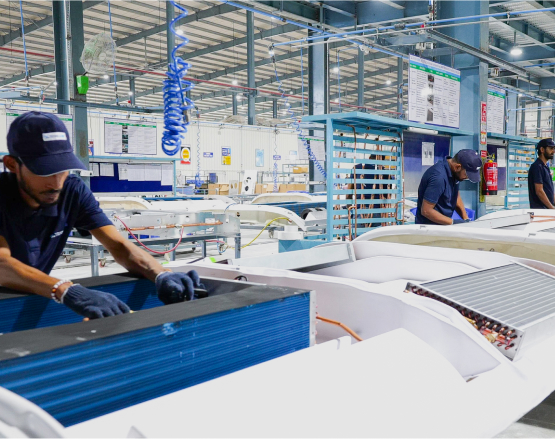
Trans ACNR Solutions Private Limited has been engaged in the design, manufacture, and support of transport air conditioning and refrigeration systems since 2003. Operating with over 525,000 square feet of production and research and development facilities across Ghiloth in Rajasthan, Shoolagiri in Tamil Nadu, and Ras Al Khaimah in the United Arab Emirates, Trans ACNR develops bus air conditioning systems for both internal combustion engine and electric bus platforms under its JTAC brand.
Trans ACNR holds ISO 9001:2015, IATF 16949:2016, ISO 14001:2015, and OHSAS 18001:2007 certifications, and its research and development operations are recognised by the Department of Scientific and Industrial Research (DSIR), Government of India.
The company’s bus air conditioning systems are engineered specifically for tropical and high-ambient operating conditions; a design consideration of direct relevance in a country where peak summer temperatures regularly exceed 45°C in several states.
JTAC Bus AC Service Network
Trans ACNR operates a structured service network comprising company-owned service centres, service associates, authorised dealers, and resident engineers across major Indian cities. Fleet operators can locate their nearest service point through the Trans ACNR service centre locator at https://transacnr.com/after-sales-services.
For direct assistance, the company’s dedicated 24/7 service helpline is available at 800 800 2593.
After-Sales Support
Trans ACNR provides structured after-sales support through its service network. The scope of support available to fleet operators includes:
- 24/7 dedicated customer support for service-related queries
- Prompt response time and efficient turnaround for system repairs and troubleshooting
- Annual Maintenance Contracts (AMCs) for planned preventive maintenance, enabling operators to manage system upkeep proactively and reduce unscheduled downtime
- Genuine spare parts availability through authorised service centres and dealers, ensuring repair quality and warranty integrity
- Resident engineers based in major cities, providing on-site technical assistance for fleets with complex or high-frequency maintenance requirements
This after-sales infrastructure is a material consideration for fleet operators evaluating total cost of ownership; a bus air conditioning system that can be serviced efficiently in the field, with genuine components, delivers measurably lower lifecycle costs than one dependent on unplanned, third-party intervention.
For comprehensive information on Trans ACNR’s sales and service network coverage, visit: https://transacnr.com/locate-us/
Trans ACNR Academy
The Trans ACNR Academy, located at the company’s facilities in Rajasthan, delivers a structured twelve-month Master Level Technician Programme, producing qualified refrigeration and air conditioning technicians trained specifically on transport applications. This in-house training capability underpins the quality of technician support available through Trans ACNR’s authorised service network.
Applications Served: Bus Types and Operational Contexts
Trans ACNR’s JTAC bus air conditioning systems are designed for a range of commercial bus applications, including:
– City and intercity bus fleets operated by state transport undertakings and private operators – School and institutional bus fleets
– Luxury and semi-luxury coach services
– Tourist and charter bus applications
– Electric city buses operating under the PM-eBus Sewa and PM E-Drive programmes
– Staff and employee transport fleets
For operators running mixed fleets – with both ICE and electric buses – Trans ACNR’s product range provides a consistent technical framework across vehicle types, simplifying procurement, training, and after-sales management.
How to Connect With Trans ACNR for Bus AC Installation
Transport managers, fleet operators, bus body builders, and OEM procurement teams seeking to discuss bus AC installation requirements – whether for a single vehicle, a fleet retrofit, or an integrated OEM supply arrangement – are invited to contact Trans ACNR directly.
Our technical and commercial teams are equipped to advise on system specification, installation planning, commissioning requirements, and service arrangements tailored to the operating profile of your fleet.
Visit us at: https://transacnr.com/contact-us/ Contact us at: info@transacnr.com
For product and technical information specific to the JTAC bus air conditioning range, please visit the product section at www.transacnr.com.
Conclusion
Searching for bus AC installation near you is the first step in what should be a considered, technically informed procurement decision. The quality of installation, the qualifications of the technicians involved, the scope of after-sales support, and the geographical reach of the service partner all determine whether a bus air conditioning investment delivers the comfort, reliability, and operational economy that fleet economics demand.
India’s bus sector is in a period of significant expansion – driven by government procurement programmes, urban mobility priorities, and the accelerating transition to electric powertrains. In that environment, the choice of a qualified, certified, and experienced bus AC installation partner carries consequences that extend across the entire operational life of the vehicle.
Trans ACNR Solutions Private Limited is ready to support that decision. We encourage you to reach out and begin the conversation.