 Skip to content
Introduction: When the School Bell Rings, the Temperature Already Has
Every school morning across India, millions of children climb aboard buses, vans, Force Travellers, and coaches for journeys that can last anywhere from fifteen minutes to over an hour. They do so in a country where ambient temperatures routinely exceed 40°C across much of the subcontinent during the academic calendar; particularly in the months of March, April, and May, which coincide with examination periods, sports days, and inter-school events.
The thermal environment of a school transport vehicle is not a minor operational detail. It is a child welfare matter. Children, particularly primary school students, are among the most vulnerable to extreme weather conditions, including heat waves intensifying due to climate change – conditions that can adversely impair their development, well-being, and learning outcomes. For those using vehicles for school commutes, proper ventilation or air conditioning is important to prevent overheating and ensure comfort during the journey.
India’s school transport ecosystem is not uniform. It spans compact Tata Magic vans serving residential colonies, mid-length school buses, full-size coaches operating urban routes, and – increasingly – electric school buses introduced as part of fleet sustainability programmes. JTAC offers dedicated air conditioning solutions for school buses, engineered specifically around the thermal comfort, air quality, and safety requirements of child passengers – the most vulnerable and most demanding occupant category in the bus transport sector. School bus air conditioning is a segment where the engineering brief is fundamentally different from that of intercity or city transit buses.
This blog provides a comprehensive overview of the full range of JTAC air conditioning solutions available for school transport vehicles across all sizes and powertrain types, supported by factual product information, applicable regulatory context, and the service infrastructure that underpins long-term reliability.
JTAC Bus ACs: Essential Engineering Credentials
Trans ACNR Solutions has been developing air-conditioning and refrigeration solutions for India’s transport sector since 2003, specialising in climate control systems for Bus Air-Conditioning, Transport Refrigeration, Defence, Railways, and off-road vehicle applications, ensuring consistent reliability across diverse operational environments.
Backed by a dedicated team of over 2,100 professionals and more than 23 years of accumulated expertise, the company’s solutions are engineered to meet applicable industry standards.
JTAC systems are designed, engineered, and manufactured in India by Trans ACNR Solutions. JTAC’s indigenous R&D and manufacturing capability is central to its product development approach. Indigenous design means that every system parameter – from refrigerant circuit architecture to control software logic – is authored by Trans ACNR engineers, using knowledge built specifically around Indian operating conditions.
JTAC systems are manufactured under ISO 9001:2015 (Quality Management), IATF 16949:2016 (Automotive Quality Management), ISO 14001:2015 (Environmental Management), and OHSAS 18001:2007 (Occupational Health and Safety) certified processes. The company is backed by DSIR-recognised testing facilities, with systems engineered to perform consistently under India’s demanding high-ambient operating conditions.
JTAC manufactures bus air-conditioning systems for the entire range of applications, including school and college buses, with deployments in the school transport segment.
JTAC School Bus AC Solutions: A Vehicle-by-Vehicle Guide
India’s school transport fleet is heterogeneous. It includes compact vans serving small catchment areas, midi-buses operating fixed urban routes, full-size coaches for longer distances, and, increasingly, electric buses procured by forward-thinking institutions and state governments. JTAC’s product portfolio is structured to address each of these vehicle categories with purpose-matched engineering.
1. Small School Vans and Mini-Buses (Up to 5.5 Metres)
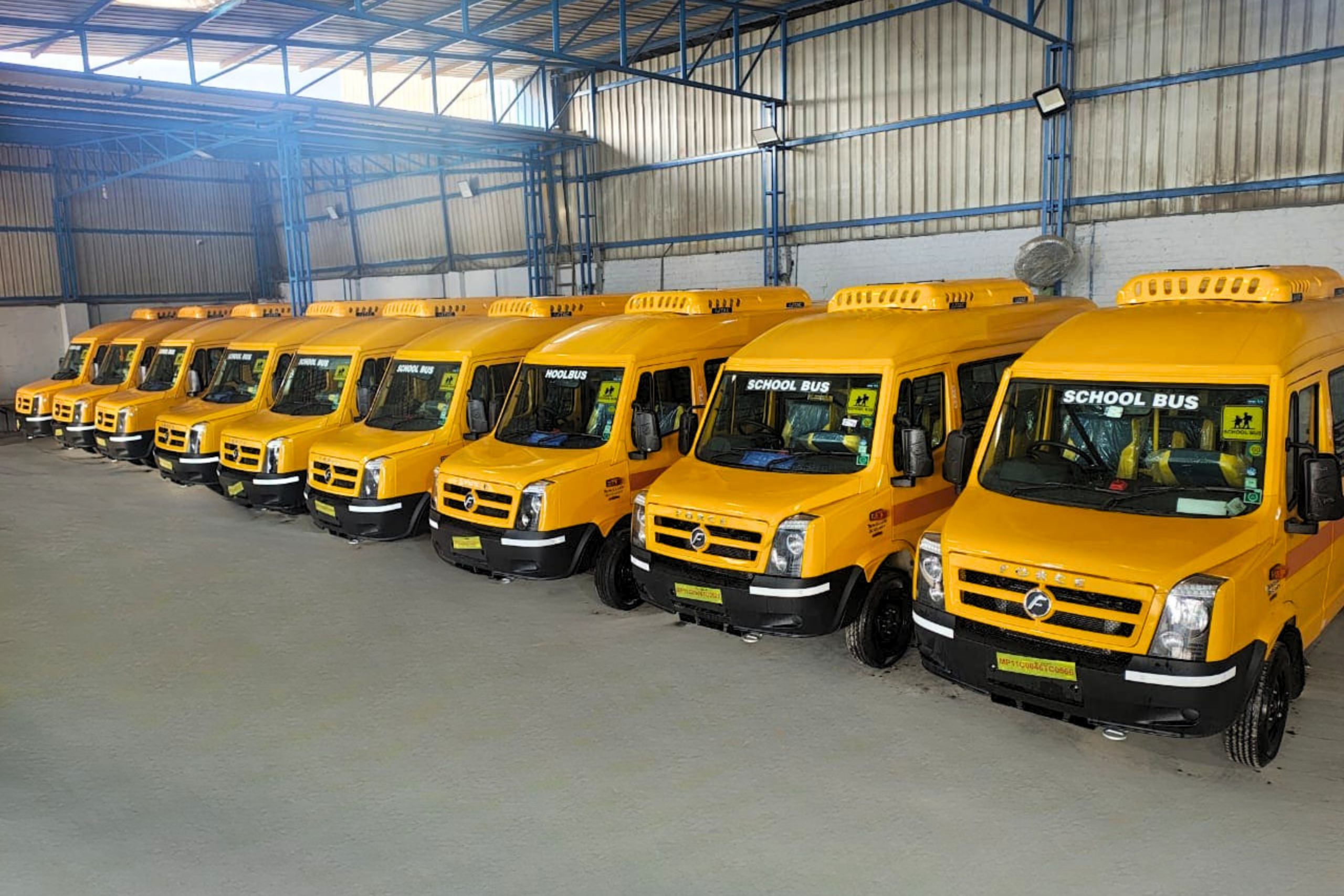
Applicable vehicles: Tata Winger, Force Urbania, Mahindra Tourister Cosmo, Tempo Traveller variants, and similar compact school transport vans
These vehicles are among the most commonly deployed for school transport in India’s urban and suburban residential catchment areas. Their compact dimensions mean that cooling systems must deliver effective performance within tight spatial and electrical constraints – typically a 12 V power supply – while remaining lightweight enough not to compromise vehicle payload ratings.
JTAC’s Snow Leopard and Astro Series for small buses is designed for buses, Force Travellers, and vans up to 5.0 metres, with a cooling capacity of 12 kW, featuring a 155 CC compressor, 2 centrifugal evaporator blowers, and 2 axial condenser fans. Both Bus AC series also include a model suitable for buses, Force Travellers, and vans up to 5.5 metres, offering a cooling capacity of 15 kW, powered by a 215 CC compressor.
Both the Snow Leopard Series and the Astro Series are compact and lightweight, making them easy to install and integrate into small-sized buses, Tempo Travellers, and vans. Using environmentally friendly refrigerants, the Snow Leopard and Astro Series help reduce environmental impact, aligning with sustainability goals. Advanced technology optimises energy consumption, helping reduce fuel costs and improving operational efficiency. The Snow Leopard Series also runs quietly, offering a peaceful and comfortable ride for passengers.
Why this matters for school transport: Children in compact vans are often seated in very close proximity, generating higher metabolic heat loads per cubic metre of cabin volume than adult passengers. Rapid cool-down upon boarding – combined with consistent temperature maintenance throughout the journey – is critical to ensuring children arrive at school in a state of readiness rather than heat-induced fatigue.
2. Midi School Buses (7.5 Metres to 9.5 Metres)
Applicable vehicles: SML Isuzu school buses, Tata Starbus midi variants, Eicher school buses, Ashok Leyland midi platforms, and Force Traveller larger configurations
This is the primary segment of the school transport fleet in India. Midi-length buses – those ranging from approximately 7.5 metres to 9.5 metres – carry the majority of institutionally organised school commuters across the country. They operate fixed routes with predictable passenger loads and are subject to rigorous regulatory oversight.
The JTAC Astro Series and Snow Leopard Series offer high-performance rooftop air conditioning solutions specifically designed for medium-sized buses and Force Travellers. Suited for buses and Tempo Travellers ranging from 7.5 metres to 9.5 metres, both the JTAC Astro Series and the JTAC Snow Leopard Series provide efficient and reliable cooling for urban, school, staff, and tourist buses.
Both the Astro Series and the Snow Leopard Series for medium buses are suitable for school and staff transport, tourism vehicles, Force Travellers, ambulances, mobile clinics, and other specialised vehicles requiring efficient climate control.
Why this matters for school transport: Midi school buses typically carry between 25 and 45 children. The challenge in this cabin format is achieving uniform airflow distribution from the front of the bus to the last row – a factor that is particularly critical when the passengers are children, who are physiologically less able to self-regulate body temperature than adults. JTAC’s Astro and Snow Leopard systems for this segment are engineered to deliver consistent thermal performance across the full cabin length.
3. Large School Coaches and Senior School Buses (10 Metres and Above)
Applicable vehicles: Tata Starbus large format, Volvo Eicher school coaches, Ashok Leyland Viking and Lynx series, SML Isuzu large platforms, and OEM school bus bodies on full-size chassis
A growing segment of India’s school transport fleet comprises full-size coaches – particularly for senior secondary institutions, residential schools, and institutions that run inter-city student transport for educational tours, examination travel, and sports events. These vehicles require high-capacity systems that can manage the thermal load of 45 to 60 students over extended journey durations.
The JTAC Astro Series and the JTAC Snow Leopard Series for large buses are designed to deliver high-performance, energy-efficient, and reliable air conditioning solutions for buses ranging from 10.5 metres to 15 metres in length. Engineered with advanced technology, they ensure consistent cooling performance across diverse climate conditions. The Astro Series and Snow Leopard Series offer cooling capacities ranging from 38 kW to 50 kW, ensuring effective cooling performance for large buses, even in the most demanding thermal environments. Centrifugal blowers ensure powerful and even airflow, providing consistent comfort across all passenger areas of the bus. Inner grooved copper tubes and hydrophilic aluminium fins for both evaporator and condenser ensure longevity and dependability.
Why this matters for school transport: Long-duration journeys – such as those undertaken for inter-school events, field trips, and examinations – place the greatest sustained thermal demand on a bus air conditioning system. Children seated in rear rows of large coaches are particularly susceptible to uneven cooling. High-capacity JTAC systems in this segment are engineered to maintain consistent cabin temperatures throughout the full length and duration of operation.
4. Electric School Buses - The JTAC Lightning Series
Applicable vehicles: Electric school buses from JBM, Olectra, SWITCH Mobility, PMI Electro Mobility, and other e-bus OEMs; CNG-electric hybrid school transport platforms
The electrification of India’s school bus fleet is no longer a future aspiration – it is an active procurement reality. State governments and private institutions are increasingly specifying electric school buses as part of broader sustainability and air quality commitments.
For electric school buses, air conditioning system selection carries additional complexity: unlike ICE vehicles, where the engine drives the compressor mechanically, electric bus HVAC systems must draw directly from the vehicle’s high-voltage battery pack. Inefficient systems can meaningfully reduce range – a critical operational constraint for school route operators who require full-day fleet availability without mid-route charging.
The JTAC Lightning Series is designed to address the evolving needs of the electric bus sector, providing energy-efficient, reliable, and safe air conditioning solutions. Advanced frequency-modulated inverter technology ensures consistent temperature regulation in high-ambient conditions.
The Lightning Series uses R-407C refrigerant for environmentally friendly cooling and features automatic adjustment of heating and cooling for optimal passenger comfort in all seasons, maintaining energy efficiency without excessive battery drain. The system ensures even air distribution across the cabin, eliminating hot or cold spots.
Why this matters for school transport: Electric school buses operated by institutions and state transport bodies are frequently purchased with the express expectation of reduced operating costs and lower lifecycle emissions. JTAC’s Lightning Series is engineered specifically around these imperatives – delivering effective cabin cooling for child passengers while protecting battery range through optimised power consumption. The in-built heating functionality is equally relevant for institutions in northern India, where students travelling in the winter months require warm cabin conditions.
The Service Infrastructure That Ensures Reliability Through the School Year
A school transport operator’s requirement of an air conditioning system is fundamentally different from that of an intercity tour operator. School buses run on fixed schedules, five or six days per week, throughout the academic year – which in India’s climate spans the most thermally demanding months of the calendar. System downtime is not a commercial inconvenience; it is a child welfare incident.
Trans ACNR offers comprehensive Annual Maintenance Contract (AMC) programmes supported by a nationwide service network spanning 100+ touchpoints across India. The company’s 1,200+ trained technicians ensure that JTAC systems operate smoothly at every scheduled service interval and in the event of unplanned breakdowns.
Trans ACNR offers a genuine spare parts distribution network integrated with its own manufacturing, ensuring availability of exact-specification components. Annual Maintenance Contracts (AMCs) and Preventive Maintenance Schedules (PMS) are available for all JTAC product lines, enabling planned maintenance at predictable cost. This network is continuously expanded and optimised in response to route development, fleet deployment patterns, and service demand data.
JTAC offers 365-day, 24-hour service support, ensuring that JTAC systems operate smoothly, anytime, anywhere. For school bus operators, this means that a system issue identified on a Friday evening can be addressed before Monday morning – preserving fleet availability across the working week.
Choosing the Right JTAC System: A Decision Framework for School Transport Operators
For school transport managers, fleet supervisors, and institutional mobility officers evaluating JTAC solutions, the selection process should be guided by the following key parameters:
Vehicle length and platform: The primary determinant of system selection is the physical length of the school transport vehicle. JTAC’s product range covers every relevant segment – from sub-5-metre vans to 12-metre electric coaches.
Powertrain type: ICE (diesel or CNG) and electric vehicles require fundamentally different HVAC architectures. The Lightning Series is purpose-engineered for battery-electric platforms and should not be substituted with ICE-designed systems.
Passenger load and cabin volume: A school van carrying 12 children has a very different thermal load profile from a midi-bus carrying 40 students. JTAC’s application engineering team can assist operators in matching cooling capacity to specific route and load profiles.
Maintenance model: Operators may choose standalone product purchase with self-managed maintenance or opt for JTAC AMC and PMS programmes that provide scheduled servicing at a predictable cost. For institutional fleets, AMC programmes typically represent a more operationally efficient approach.
Conclusion: Every Journey, Every Child
The school bus is one of the few environments in a child’s day that is entirely within the operational control of an institution or transport provider. The temperature of that environment – whether it supports alertness, comfort, and well-being, or subjects a child to avoidable heat stress before a school day has even begun – is a direct consequence of the engineering and investment decisions made by fleet operators, school administrators, and transport managers.
JTAC’s comprehensive portfolio of school bus air conditioning solutions – spanning compact vans, midi-buses, large coaches, and electric school transport platforms – is built on more than two decades of application-specific engineering, a DSIR-recognised research and development programme, and a nationwide service infrastructure that prioritises fleet availability throughout the academic year.
JTAC systems are engineered to support cooler, more comfortable journeys for child passengers – contributing to their comfort and well-being upon arrival at school. That engineering objective guides Trans ACNR Solutions Private Limited and its JTAC brand across every journey, every child, every day.
For product specifications, fleet assessment support, AMC enquiries, or to locate your nearest JTAC bus AC service centre, please visit: www.transacnr.com