 Skip to content
Practical Considerations for EV Thermal Management Solutions in Commercial Bus and Truck Applications
Why Thermal Management Is the Silent Backbone of Every Electric Vehicle
As India’s commercial vehicle industry accelerates towards electrification – driven by government policy, urban air quality imperatives, and fleet operator economics – one engineering challenge continues to define the difference between a reliable electric vehicle and a costly operational liability: thermal management.
In an electric bus or electric truck, heat is both unavoidable and consequential. Lithium-ion battery packs, traction motors, power electronics, and passenger cabin systems each generate thermal loads that – left unmanaged – degrade performance, shorten battery life, and, in worst-case scenarios, compromise passenger and driver safety. India’s tropical and high-ambient climate, where peak summer temperatures in cities such as Delhi and Nagpur regularly exceed 45°C according to India Meteorological Department records, while high-humidity cities such as Chennai and coastal centres compound thermal stress through elevated wet-bulb conditions, makes these challenges substantially more demanding.
Effective EV thermal management is not an accessory. It is the engineering foundation upon which the operational viability of every electric commercial vehicle depends.
Comprehensive EV Thermal Management for Air-Conditioned Electric Buses
For operators running air-conditioned electric bus fleets – across city bus contracts, state transport undertakings, and private inter-city services – Trans ACNR Solutions delivers an integrated suite of thermal systems designed to address the principal thermal sources within the vehicle in a coordinated manner.
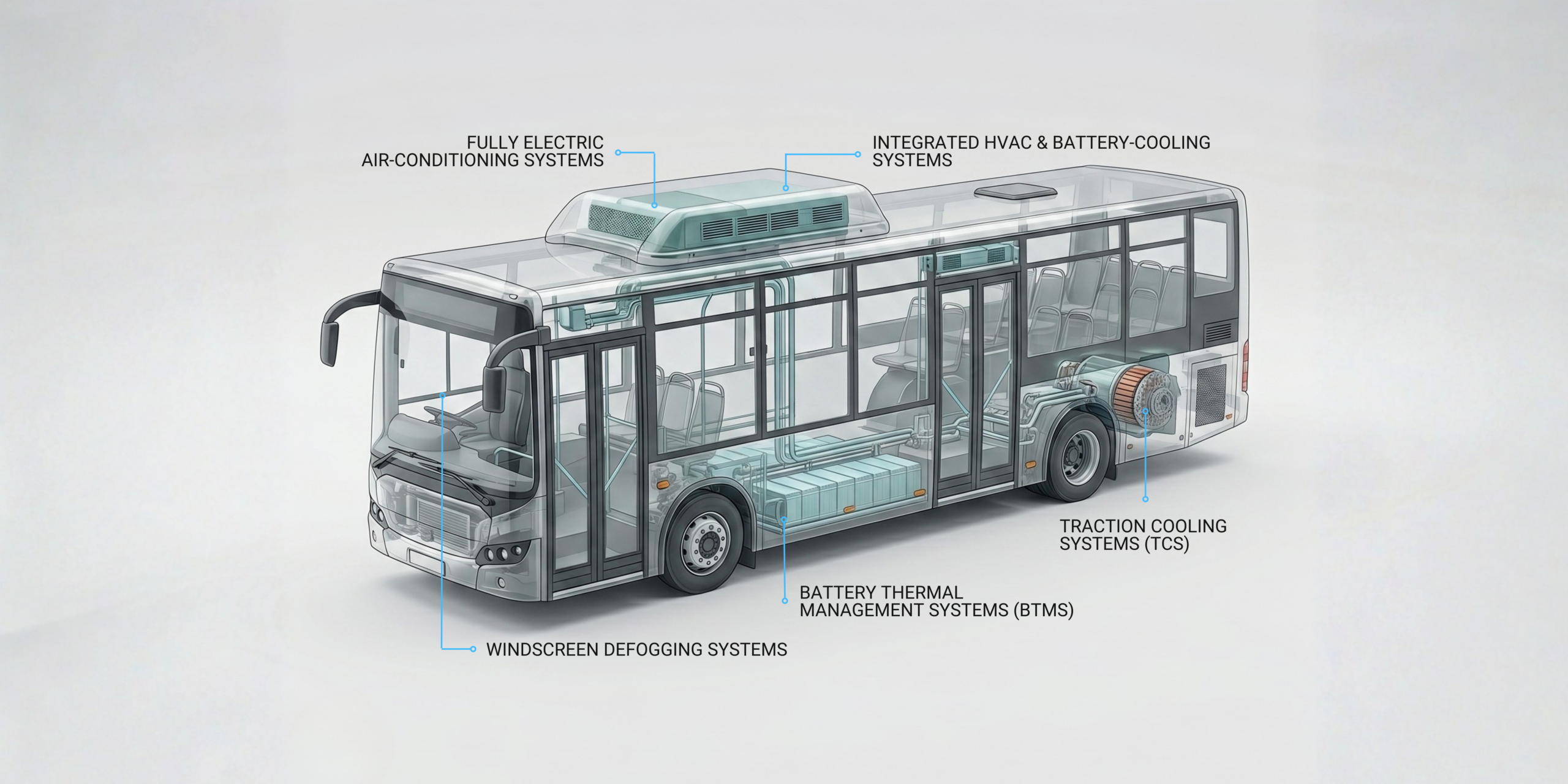
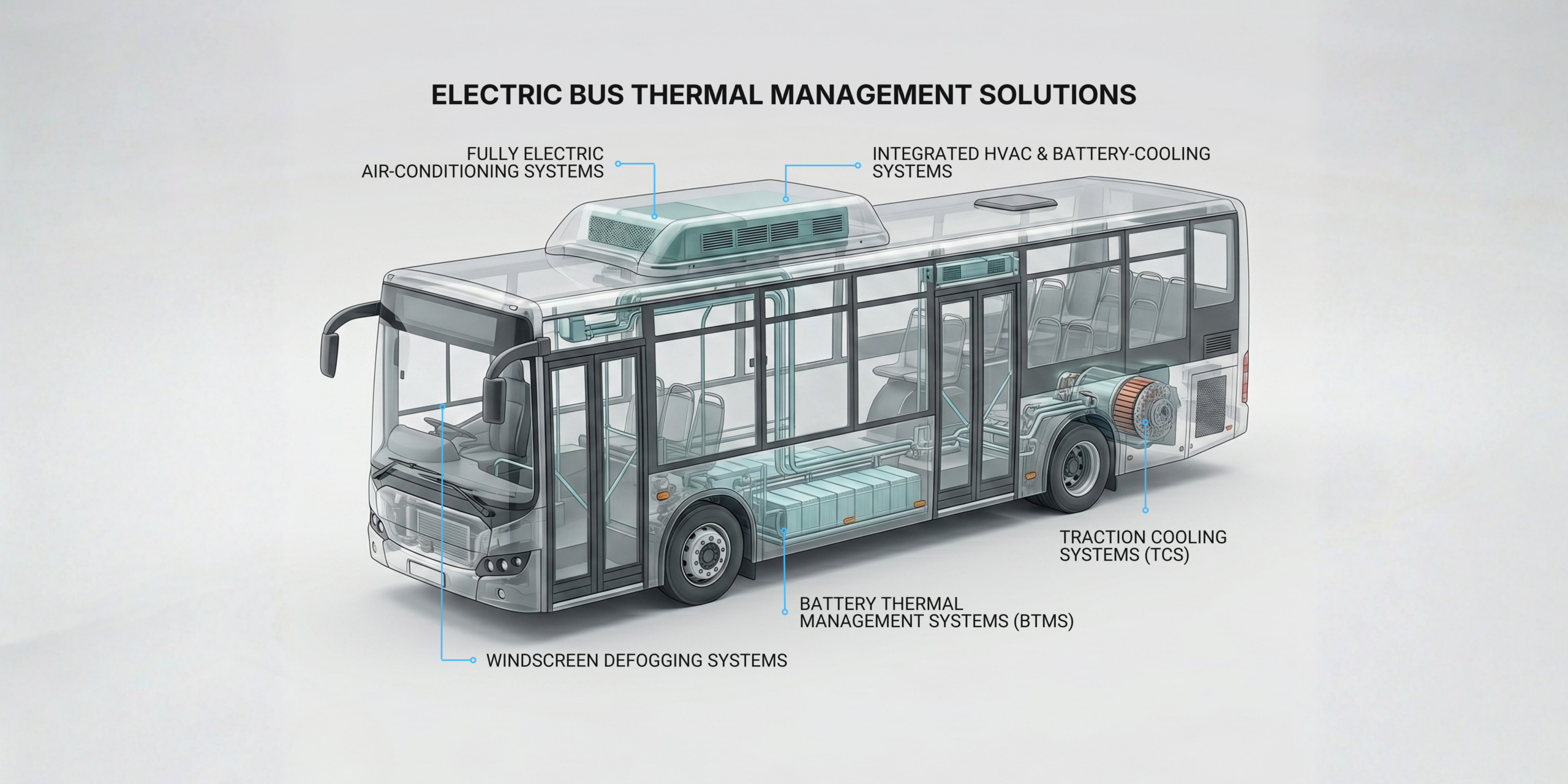
As illustrated in the Trans ACNR Electric Bus Thermal Management Solutions graphic, the portfolio for air-conditioned electric buses encompasses five closely interlinked systems:
Fully Electric Air-Conditioning Systems
Unlike conventional belt-driven or engine-dependent compressor systems, Trans ACNR’s fully electric air-conditioning units operate independently of any internal combustion architecture. Engineered specifically for high-ambient tropical environments, these systems maintain reliable cabin comfort without placing parasitic thermal loads on the battery pack – a balance that is critical to preserving operational range across a full duty cycle.
Integrated HVAC and Battery-Cooling Systems
Managing the thermal environment of both the passenger cabin and the high-voltage battery pack within a unified, engineered architecture reduces system complexity, lowers the total weight penalty, and eliminates the inefficiencies associated with running two wholly separate thermal circuits. Trans ACNR’s integrated approach ensures that heating, ventilation, air-conditioning, and battery-cooling functions are coordinated to optimise total vehicle energy consumption.
Battery Thermal Management Systems (BTMS)
The battery pack is the most capital-intensive component of any electric bus. Trans ACNR’s Battery Thermal Management Systems are designed to maintain battery cells within their optimal operating temperature window – a range that, across common lithium-ion chemistries, spans broadly between 15°C and 40°C depending on cell type, charge state, and operating mode – throughout all operating conditions.
Doing so directly supports battery longevity, sustains charging and discharging efficiency, and reduces the likelihood of thermal runaway events. For fleet operators, effective BTMS translates to lower total cost of ownership, sustained battery capacity across multi-year operational cycles, and a more consistent vehicle availability profile.
Traction Cooling Systems (TCS)
The traction motor and its associated power electronics generate significant heat under load – particularly during city-cycle operation characterised by frequent stop-start patterns. Trans ACNR’s Traction Cooling Systems manage the thermal profile of these powertrain components to sustain performance levels across extended operational periods, reducing thermal-induced downtime and maintenance frequency.
Windscreen Defogging Systems
In high-humidity conditions – prevalent across coastal cities such as Mumbai, Kochi, Chennai, and Kolkata, as well as during India’s monsoon season – windscreen fogging poses a direct safety risk. Trans ACNR’s electric defogging systems restore forward visibility efficiently and without drawing disproportionate energy from the main battery pack.
BTMS and TCS for Non-Air-Conditioned Electric Buses and Electric Trucks
A critical and frequently overlooked reality of India’s electric fleet transition is that a significant proportion of electric commercial vehicles do not carry passenger-facing air-conditioning systems. Non-air-conditioned electric buses – widely deployed in peri-urban, rural, and last-mile connectivity roles under state and central government schemes – and electric trucks operating in freight, cold-chain logistics, and last-mile delivery segments all require dedicated thermal protection for their battery and powertrain systems, irrespective of whether passenger cabin comfort is part of the vehicle specification.
Trans ACNR explicitly addresses this segment. Battery Thermal Management Systems (BTMS) and Traction Cooling Systems (TCS) are available as standalone, vehicle-class-appropriate solutions for non-air-conditioned electric buses and electric trucks.
For electric truck operators, effective BTMS is particularly consequential. Commercial freight cycles – characterised by heavy loads, extended highway running, and variable ambient temperatures across diverse Indian geographies – place sustained thermal stress on battery systems. Without engineered cooling, battery degradation accelerates, effective range diminishes, and total operating cost increases. Trans ACNR’s BTMS solutions for the commercial truck segment are designed to perform reliably across the full spectrum of Indian operating environments, from the plains of Uttar Pradesh and Rajasthan to the high-altitude corridors of Himachal Pradesh and Uttarakhand.
For non-air-conditioned electric bus operators, the priority is identical: protecting the battery asset that underpins route reliability and fleet economics, ensuring that vehicles operate consistently across multi-shift daily duty cycles.
Conclusion: Selecting a Reliable, Nationwide EV Thermal Partner for the Indian Market
India’s transition to electric commercial vehicles represents a structural shift in transport infrastructure – one that will be shaped not only by the pace of vehicle procurement, but by the operational reliability those vehicles demonstrate in daily service.
Trans ACNR Solutions brings over two decades of experience in transport HVAC and thermal engineering, with production and R&D facilities exceeding 525,000 sq. ft. across India and the UAE. Our engagement spans bus and railway air-conditioning, truck refrigeration, and the full spectrum of EV thermal systems – BTMS, TCS, integrated HVAC-battery cooling, and electric defogging – serving OEMs, bus body builders, fleet operators, and state transport undertakings across the country.
Our solutions are designed and delivered in India, for Indian conditions. The thermal challenges posed by the subcontinent’s diverse climate, high-ambient temperatures, and demanding duty cycles are not abstractions in our engineering process – they are its starting point.
Explore Our EV Thermal Management Solutions
We invite fleet operators, OEMs, bus body builders, and procurement decision-makers to explore the Trans ACNR Electric Bus Thermal Management Solutions portfolio in detail.
Visit us at: www.transacnr.com
For technical enquiries or to discuss your fleet’s specific thermal management requirements, please connect with our solutions team through our website.